
The 2026 MLB First-Year Player Draft is upon us this weekend, bringing a massive wave of high-ceiling talent ready to reshape franchise futures. Before we dive into the deep-dive stories on our radar, here is a quick rundown of how the top 10 projected selections are shaping up according to the latest industry consensus and mock data:
- Chicago White Sox: Roch Cholowsky, SS, UCLA
- Tampa Bay Rays: Grady Emerson, SS, Fort Worth Christian HS (TX)
- Minnesota Twins: Vahn Lackey, C, Georgia Tech
- San Francisco Giants: Jacob Lombard, SS, Gulliver Prep HS (FL)
- Pittsburgh Pirates: Eric Booth Jr., OF, Oak Grove HS (MS)
- Royals: Jackson Flora, RHP, UC Santa Barbara
- Orioles: Drew Burress, OF, Georgia Tech
- Athletics: Ryder Helfrick, C, Arkansas
- Braves: Gio Rojas, LHP, Stoneman Douglas HS (FL)
- Rockies: AJ Gracia, OF, Virginia
The text messages invariably start rolling in days or hours before the MLB Draft starts. They come from friends who only casually watch, or from family members who glanced at the baseball web pages and saw the optimistic mock drafts detailing the future heroes of baseball.
I’m always excited for whoever’s name is called at the ten slot, but in the back of my mind I’m hoping that this kid makes it. Because when I look at the number ten stamped next to a kid’s name on a draft board, I don’t see a lock. I see a warning track. I see an invisible fault line running right through the heart of the first round.
We are conditioned to believe that the top ten is holy ground in professional sports. In the NFL or NBA, a top ten pick is a franchise cornerstone wrapped in a bow, right out of the box superstar. But Major League Baseball is an entirely different beast. It is a sport of brutal attrition, endless bus rides, and a developmental ladder so steep that it swallows high school phenoms and college giants alike without leaving a trace. And if you trace that ladder back over the last twenty five years, you’ll find that the tenth overall pick isn’t a launchpad. More often than not, it’s a silent career killer.
My obsession with this specific quirk of baseball history didn’t start with analytics or by sorting through columns of WAR on a spreadsheet. It started twenty-six years ago on a hot minor league diamond in the summer of 2000. That was the year I first fell in love with minor league baseball. It was a world of cheap hot dogs, local radio broadcasts, and the raw hope of chasing a dream. That summer, I got to watch, and meet a young left-handed pitcher named Joe Torres.
He was the 10th overall pick in the 2000 draft by the Anaheim Angels. He was a high school phenom out of the Bronx with a smooth delivery and a ceiling that looked as high as the stadium lights. To any fan he was a “Top Ten Pick” set to start his career in Boise. How could he possibly miss?
Torres threw 610 minor league innings over his career. He battled his own mechanics, fought through the existential dread of the minor league grind, and watched his arm slowly betray him until he maxed out at Triple-A. He never threw a single pitch in the Major Leagues. Joe Torres didn’t know it at the time, but he was setting the tone for the new millennium. He was the harbinger of a generation long jinx.
Since that summer of 2000, the No. 10 spot has been an absolute minefield. Approximately 33% of the players taken there between 2000 and 2020 never even touched a big league field, and more than half finished their professional stints providing zero or negative WAR to in their careers. When we think of a draft “bust,” we tend to think of laziness, not being able to assimilate to the life of a professional player, or catastrophic, sudden failures. But the reality of the modern baseball bust is far quieter, far more heartbreaking, and usually defined by a body that simply breaks under the weight of expectation. To understand just how suffocating the weight of that number ten slot can be, you don’t look at the guys who lacked the tools. You look at the ones who had absolutely all of them.
For me, that realization took place on July 20, 2019. Right in the middle of me writing my book and documenting the 2019 River Cats season, I was on a road trip to where my minor league baseball experience had originally begun nineteen years earlier: Memorial Stadium in Boise, Idaho. It was a journey fueled by nostalgia, terrible sleep, and a cheap hotel room nightmare that ended with me stripping back stained sheets at midnight, panic checking for bed bugs, and fleeing to sleep in my car outside a random warehouse. I was there to see the Salem-Keizer Volcanoes, the short season affiliate of the San Francisco Giants. More specifically, I was there to see the man the Giants had taken with the number 10 overall pick just a month earlier, Hunter Bishop.

On draft night, the pick felt like destiny. Bishop was a local kid out of Serra High School in Palo Alto who had gone on to terrorize college pitching at Arizona State. He was a left handed power hitting outfielder with an athletic frame. Standing near the dugout during batting practice, looking at the fresh, baby faced roster of college kids getting their first taste of professional baseball, Bishop looked like a man among boys. He was an obvious choice. A future anchor for a Major League lineup.
Before the game, I had a chance to talk to Bishop about his transition to the pros. He was ten games into his professional career, riding high on the optimism of a multi-million dollar signing bonus and a clean slate. He told me he really liked starting his pro ball career, and while he liked college, pro ball matched his personal work ethic. He explained that teams put it upon the players to put in all the work, and he prided himself on being the hardest worker on the field, which had made it a great transition so far. He credited his older brother, Braden, who was currently grinding through Triple-A with the Tacoma Rainiers, with helping him navigate the ups and downs he would come across. There was no fear in his voice. Why would there be? When you are 21 years old, built like a brick wall, and possess a lightning fast swing, the minor leagues look like a minor speed bump on the road to Oracle Park.
That night in Boise, the game was wild, sloppy, and beautiful. It took ten innings and four grueling hours for the Volcanoes to pull out a 15-12 win. If you watched closely, you could see the massive gulf between low-A ball and the majors; guys were swinging through heaters and misjudging breaking balls. But the hope was obvious. I left the ballpark that night thinking about the day I’d get to watch Hunter Bishop step onto the grass at Raley Field in a Sacramento River Cats uniform, just one phone call away from the big leagues.
He never made it to the Majors. It wasn’t a lack of work ethic. It wasn’t a lack of tools. It was the slow, agonizing reality of the No. 10 landmine. First came the pandemic in 2020, wiping out a crucial year of development. Then, the injuries began their relentless march. A shoulder strain here. A torn oblique there. Finally, a devastating UCL injury that required Tommy John surgery. The hardest worker on the field was trapped in a training room for years. Today, Hunter Bishop is quietly out of professional baseball entirely, electing free agency after the 2025 season to explore other opportunities without ever seeing a single Major League pitch. While he couldn’t be reached to look back on his journey for this piece, the stark contrast of his past is one that is hard to ignore.
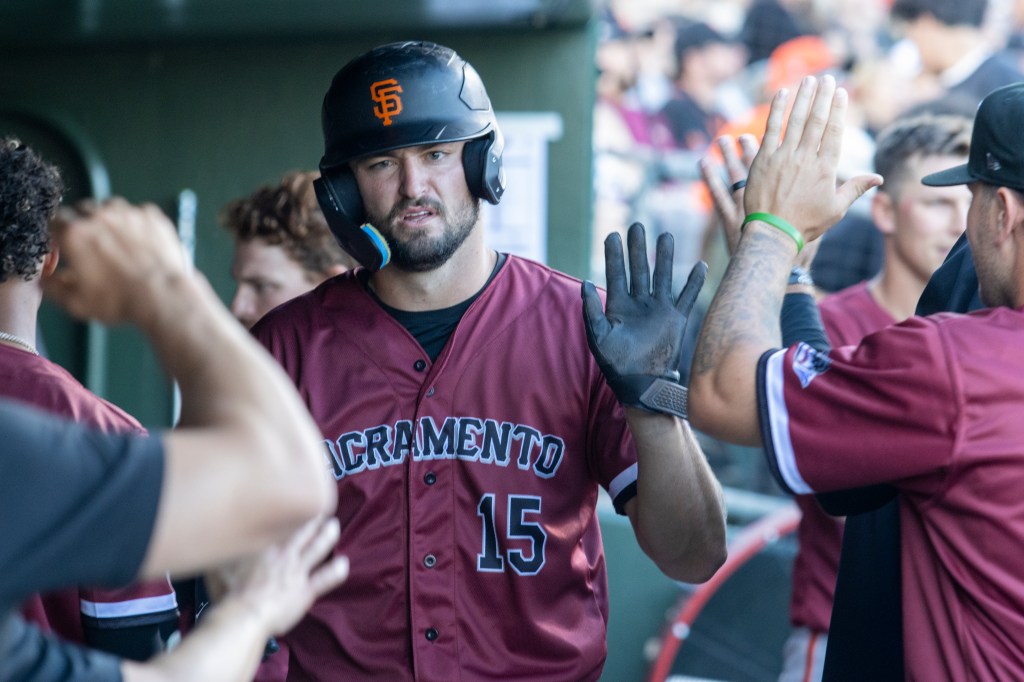
There is a beautiful, cruel irony to standing next to a minor league batting cage. You think you can spot the future just by looking at the draft pedigree, but baseball has a funny way of blind siding your expectations. On that warm July night in 2019, my eyes were glued to Bishop. But if you panned the camera out across the rest of that Salem-Keizer Volcanoes roster, you’d realize that the real future of the San Francisco Giants franchise wasn’t the marquee savior. The real future was a kid taken four rounds later, quietly waiting his turn in the shadow of the grandstand, Tyler Fitzgerald. Fitzgerald, a 4th round infielder out of Louisville, didn’t command the local headlines or the Barry Bonds comparisons. Yet, when their paths diverged into the unforgiving machine of professional development, it was Fitzgerald who outran the landmines, eventually exploding onto the scene in San Francisco to tie rookie home run marks and lock down a crucial everyday role.
And the contrast only got sharper if you looked across the diamond into the home dugout of the Boise Hawks. Michael Toglia, the Rockies’ top pick that summer out of UCLA was in the lineup and has since carved out a consistent presence in the middle of Colorado’s order until he was released last fall, but then signing with the Red. But hiding right in plain sight on that exact same 2019 Boise roster was a skinny, 17 year old kid from Venezuela named Ezequiel Tovar. In 2019, Tovar was just a blip at the bottom of a Short Season lineup. Yet, he would skyrocket through the minors to become an elite, Gold Glove caliber shortstop and one of the faces of the modern Colorado Rockies franchise.
Think about the sheer weight of that specific July evening. You have a stadium containing a 17 year old international long shot destined to be a star, a 4th round college grinder built for big league records, and a classic first round corner infielder who made it out as the 23rd overall pick. And yet, the young man with the highest draft pedigree, the biggest signing bonus, and the highest ceiling, the 10 overall pick Hunter Bishop would be the only one among them to never experience a single Major League game.
To be completely fair, the universe has briefly glitched and allowed a rare few to conquer this curse in this Century. If you look at the entire twenty five year timeline, a tiny three year miracle window cracked open where the 10 slot was pure magic. It required a legendary, once in a generation San Francisco scouting department to pull off the heist, drafting “The Freak” Tim Lincecum in 2006 and postseason icon Madison Bumgarner back-to-back in 2007. The only other player to stand tall in that elite tier was outfielder Michael Conforto, taken 10th overall by the New York Mets in 2014, who shattered the narrative by slugging his way to an All-Star nod and a highly productive, decade long big league career.
But outside of those three, the modern era has only reinforced the jinx and even producing the most bizarre asterisk in draft history with Kumar Rocker in 2021. Selected 10th overall by the Mets, Rocker’s medical review famously spooked the front office. He left unsigned, essentially rejecting the fate of the 10th slot entirely. He had to re-enter the draft, get selected 3rd overall by the Texas Rangers the following year, and walk an entirely different path to finally make his Major League debut. To find success, he literally had to escape the shadow of the number 10 designation.
Yet, if you look closely at how these stories evolve, you realize that a busted draft slot doesn’t always mean a busted baseball life. Sometimes, the landmines of the minor leagues simply force a man to find an entirely different path to the Show. Take Joe Torres, the very player who started this millennium’s pattern. His arm may have betrayed him on those minor league mounds, but the baseball IQ that made him a top ten pick never left. Nearly two decades after the Angels called his name, Torres quietly began a brilliant, steady ascent back up the organizational ladder, but this time with a clipboard instead of a glove. In 2017, he was the pitching coach for the Arizona League Indians. He coached for the Lake County Captains in 2018 and the Lynchburg Hillcats in 2019. After the 2019 season, Cleveland named Torres their minor league pitching coordinator. He was then named assistant pitching coach on the major league staff before the 2022 season, and a position he still holds today. Twenty two years after he was drafted, Joe Torres finally made it to the Majors. He didn’t do it throwing 95 mph gas as a lefty, but he did it by standing on a big league top step, proving that while the 10th slot might be a silent career killer for a player, a true baseball life finds a way to beat the house.
And even when a player does buck the trend to debut under the banner of the tenth slot, the journey remains the same high stakes gamble. Look at the most recent number ten pick to successfully debut in the Major Leagues, right handed pitcher Gabriel Hughes. Selected 10th overall by the Colorado Rockies in 2022 out of Gonzaga, Hughes ran headfirst into the landmine almost immediately, undergoing Tommy John surgery that stole his 2024 development. Yet, after a grueling path back through rehab, Hughes fought his way to a July 3, 2026 debut at Coors Field against the San Francisco Giants, throwing three scoreless frames of relief to secure his first big league save. He beat the house to get there, but the narrow tightrope he walked to do it only underscores the reality of the slot.
Which brings us back to the draft board sitting in front of us this weekend. Once you get past the elite, consensus top tier of prospects, this year’s draft rapidly devolves into a complete crapshoot based entirely on organizational risk tolerance. If by some absolute miracle Georgia Tech outfielder Drew Burress slides down the board, he represents a team’s best possible shot at breaking the jinx. Burress is a well polished college bat with elite contact tools and an approach that could fast track him to the major Leagues. But all but two mock drafts I’ve reviewed say he won’t be there.
Instead, the teams picking at the turn of the top ten are going to be forced into a high stakes game of roulette. They will have to look at a player like Kentucky shortstop Tyler Bell, who spent his season raking through college ball while playing through a significant shoulder injury. Or they will have to evaluate Arkansas catcher Ryder Helfrick, an incredibly athletic backstop with a premium defensive profile but carries the physical wear and tear risks that come with being a college catcher. Even a high upside player like Zion Rose brings a swing profile that forces scouts to balance star potential against a very risky floor.
It is the ultimate cautionary tale for the weekend ahead. As the Colorado Rockies prepare to lock in on a kid like AJ Gracia at the #10 spot. Fans will dream of franchise stardom. They will look at the tools, the hit profiles, and scout grades, and they will dream of his future. But history tells a vastly different story. In the game of baseball, the top ten isn’t a guarantee of greatness. Sometimes, it’s just the highest pedestal from which to fall.


